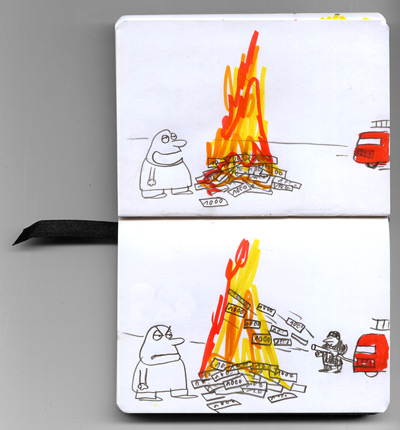
Genius idea. Plus - if there still are people willing to pay 100 bucks to have the demise of their stock market portfolio embroidered on a handkerchief, things can't be that bad.. yet.
via merely thinking and swissmiss

DAY 16: Obama's "First 100 Days Dilbert Desk Calendar" still on day five.
DAY 14: Taco Tuesday
DAY 13: President Obama meets with Vermont governor Jim Douglas and is saddened to find that he is not the creator of Garfield.

no difference between "found" poetry and "composed" poetry.
not possible to isolate the conscious or the subconscious.
no difference between pattern and chaos.
"right" and "wrong"; "good" and "bad"; "correct" and "incorrect", are superstitious terms; all language is "true".
All language is hiding something.
Was kann ich sagen, als dass ich Dich liebe; was versprechen, als was in dem Worte Liebe schon liegt, Treue? Aber die sogenannte Versorgung? Student noch zwei Jahre, die gewisse Aussicht auf ein stürmisches Leben, vielleicht bald auf fremden Boden!
(What can I say but that I love you, what can I promise but what is already whithin the word love, loyalty? But the so-called support? A student for another two years, the certain prospect of a turbulent life, soon maybe on foreign soil!)*
reminds me of myself last year / it feels like 10 years ago from the now and here /
When love finally does leave the room, where does it go?
It goes to the sky bar at the Mondrian in LA and fucks with someone else.
“Even as he is sober about these challenges, I have never seen him happier,” Mr. Axelrod said. “The chance to be under the same roof with his kids, essentially to live over the store, to be able to see them whenever he wants, to wake up with them, have breakfast and dinner with them — that has made him a very happy man.”

Just hours earlier, Mr. Obama called for speedy passage of the stimulus measure, warning that the recession “could linger for years” if Congress did not pass his plan within weeks.
First, women need to recognize how a man understands a wife's refusal to have sex with him: A husband knows that his wife loves him first and foremost by her willingness to give her body to him. This is rarely the case for women. Few women know their husband loves them because he gives her his body (the idea sounds almost funny).

But nowhere are attitudes toward sex and gender quite as elastic as in the far reaches of the southern state of Oaxaca. There, in the indigenous communities around the town of Juchitán, the world is not divided simply into gay and straight. The local Zapotec people have made room for a third category, which they call "muxes" (pronounced MOO-shays) -- men who consider themselves women and live in a socially sanctioned netherworld between the two genders.
"Muxe" is a Zapotec word derived from the Spanish "mujer," or woman; it is reserved for males who, from boyhood, have felt themselves drawn to living as a woman, anticipating roles set out for them by the community.


Walters then pointed out that he himself had used the lipstick line, but McCain held that Obama "chooses his words very carefully" and the reference was no accident.
(via NPR)
Because Wide Sargasso Sea can be seen, and was intended as, an answer and expansion to Jane Eyre I couldn't help but mainly focusing on the similarities and differences between these two novels. And there are plenty. On the one hand, there is the narrative voice. Of course, this difference is pretty obvious, as Jane Eyre is pretty much a classic example of an Victorian novel with a first person narrator that is as reliable as a first person narrator can be. But, I think, what is striking about Jane Eyre's narrative voice is that it is mature and self-assure in its tone, although through important parts of the book Jane is either young or confused or both. This is quite different in Jean Rhys's novel. Not only does the narrative voice change in the different parts of the novel, the narrative voices, in my opinion, are also at times more personal and often fittingly insecure. Especially in the first part of the book, concerning Antoinette's childhood dominated by confusion and anxiety as a result of the neglect of her mother and these sense of being in-between groups. This cannot only be felt in what is narrated, it can be also seen in how it is narrated, especially during the scene in which her family's house is burnt down.
An interesting commonality I see between Jane and Antoinette is the place the school – boarding or convent – takes in their lives. Both grew up in a insecure, rather harsh home in which both have to struggle with neglect and animosities. The prospect of going to school is a possibility of a safe haven. Both still have to struggle in school, but at least for Jane this more or less works out, she meets and finds friends in important and influential female figures in her life. Antoinette also considers the convent her refuge, but things do not work out as fine as they do for Jane.
The narrative voice in the second part of the novel is the point of view of Mr. Rochester. He, in my opinion, has some common features with Marlow's perspective in Heart of Darkness. He is also an Englishman in a situation and setting he fails to understand, recognize ,accept or at least tolerate when he visits Antoinette, her home and her family. Suspicious of all conventions and habits that in some way oppose or do not fit to 'proper' Victorian, English conventions. He tries to force everything into these conventions. This goes as far as renaming his wife Antoinette Bertha, in order to make her more English. Also, although he marries her, this is merely a convenient business and financial, rational act for him. Nd he treats the relationship with the professional, cold, matter-of-fact, one might say Colonialist attitude appropriate for the relation between two parties of a contract, but not of two lovers, at least in our modern understanding, despite all sexual contact.
Bertha is quite confused by this situation, desperately wanting him to love her, and even more confused, if not anxious, about the looming unknown goal and image that is England. To her this idealized place of Rochester's appears cold and scary, I think.
The novel appears to point out that this being torn between two her Caribbean self – which isn't all that stable either – and and the English other is part of the reasons that turn her into the madwoman in Jane Eyre. The book also seems to present the idea that Antoinette/Bertha appears 'mad' because the English society makes her appear mad by force and treat her accordingly. This makes me think of Said's Orientalism and the way i.e. African 'savages' are portrayed by Colonial powers such as Marlow in Conrad's Heart of Darkness.

If our system were truly about what harms, we would promptly legalize currently illegal things that are harmless -- gay marriage, pot, and Mexicans. Then we would criminalize currently legal things that are harmful -- nuclear weapons, Hummers, and the Gypsy Kings.


"'Well, you know right now America is in a state of upheaval,' he says. 'Poverty is demoralising. You can't expect people to have the virtue of purity when they are poor. But we've got this guy out there now who is redefining the nature of politics from the ground up... Barack Obama. He's redefining what a politician is, so we'll have to see how things play out. Am I hopeful? Yes, I'm hopeful that things might change."

I thought that it was interesting how lê thi diem thúy's novel The Gangster We Are All Looking For takes up the discussion of the blend of fiction and auto-biography we had when reading Kingston. The book is classified as fiction, and that is correct and true, but I still can't get around the striking similarities between the narrator and the author. Both came form Vietnam by boat, both lost a sibling through drowning. Normally, I don't like to take the autobiographical approach to a text. But in this case, it is so interesting, especially since lê herself made some decisions that pint towards this interpretation.
First, the autobiographical information is given in the book itself. And not only by the publishing company, in which case one could have argued that they tried to force a autobiographical connection between author and work to raise public interest i the book. But lê also includes the autobiographical in her author's note.
Further, lê decides to keep the author nameless, which has two results. The narrator is of a more general, floating character, the reader can give the narrator more identity. But in this case it is very likely that the reader simply takes the name for the narrator closest available – the author's voice. Of course, it is quite common for authors to use a lot autobiographical background as inspiration, but still I would argue that in this case, the border between author and fictional narrator is exceptionally blurred.
I rarely read a novel in which case the comments on the back fit so well with my own perception of the book as in this case. The Vogue quote says: “Breathtaking [..] Flows in luminous paragraphs that mingle past and present, creating a fluid sense of time”. I couldn't say it differently. I especially liked how the quite short paragraphs were so divided from each other. Sometimes the paragraphs felt just like a little shot, a little glimpse of time, in some cases the book was almost impressionistic. I was fascinated how the narrative pace suddenly changed halfway through the book, and a more or less external account of immigration turned into a quite emotional family story. I felt like being in a narrative swirl. And what especially fascinated me was that although all three family members were struggling in their own way, I never saw them a completely detached from each other. Somehow there always seem a loving connection between them. The way it was narrated, for example, the makeup process between mother and father after drunken rage and arguments never seemed like a bad idea to me, as in other cases. Despite all the strangeness and problems, this family still seemed to belong to each other.